Judy Felson Duchan, February 29, 2016, amended April 13, 2025
My grandmother Esther’s maiden name was Busel. Busel was a very common name among Jews in late 19th century Lyakhovichi, a shtetl in Eastern Europe. Click here to read about my history of the town. The Surname Index of the Lyakhovichi website lists 447 people named Busel! (Many of these are duplicates, though. I couldn’t tell which. Nonetheless, there were a lot of Busels in those years.) It wasn’t until 1795 that Jews in the Russian Pale of Settlement were required to have last names. That was the year Poland was subdivided into three distinct areas, each annexed to a nation surrounding it: Prussia, Austria, and Russia. Lyakhovichi at that point became part of the Russian empire.
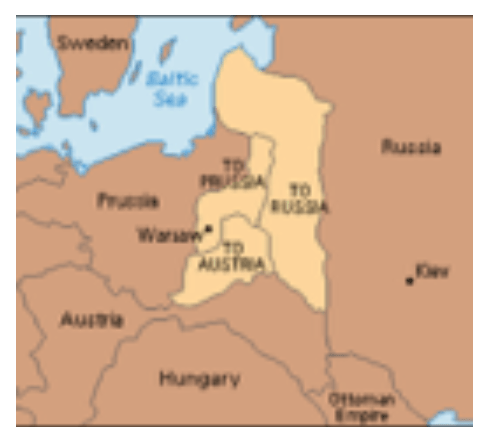
The Russians worked much harder at keeping tabs on its populace than did the Poles. In 1804 Russia decreed that Jews all over Russia assume last names. The Russians did this so they could track Jews for purposes of taxation and conscription into the military, and to expedite any legal processes such as transfers of property.
According to a Lyakhovichi historian, Deborah Glassman, the name Busel was created as a salute to a revered rabbi who wrote an important book in the middle ages. His name was Rabbi Eleazar, sometimes referred to as “The Pious.” Eleazar’s descendants living in the late 17th century named themselves Busel, meaning humble, as a way to pay homage to Rabbi Eleazar. Ironically, those Busel humble genes (if their name related to personal traits) must have become recessive when combined with Felson genes. The personalities of those 8 Felson siblings (and their offspring) were anything but humble.
Those who took the name Busel spelled it in different ways:

Not all Busels were or are Jewish. Nor is it a name used only by those in Eastern Europe. If you enter the name Busel in the white pages listing people in the United States alone, you get 90 exact hits and 85,002 hits for the various spellings of Busel.
The Busels in Lyakhovichi were not necessarily related to one another. Some, of course, were relatives, but it is hard to trace which families were related or to find out how they were related. Nonetheless It is my guess that nearly all of those with Busel names knew one another. Here is some information pointing to that conclusion: Samuel Kassow, a scholar who studies the shtetls and history of the Ashkenazi Jews, hypothesizes that everyone in shtetl towns the size of Lyakhovichi must have known one another. The close affinities of residents of Lyakhovichi around 1911 is beautifully depicted by Avrom Lev, a Jew who left the town at the outbreak of World War I. Later in his life (around 1951) he imagined taking a nostalgic walk through “his devastated shtetl” remembering who lived on various streets before he left. He describes with fondness and familiarity former residents of the shtetl who either migrated or were killed in the holocaust.
It is difficult to determine the nature of particular cross-family relationships from this distance in time and place. Were, for example, our grandmother and great aunt, Esther and Eval Busel, related to Joseph and Hayuta Busel, who also grew up in the town at about the same time? For years, genealogists from different branches of Esther and Eva’s family have been trying to determine whether the two families are blood related. The reason for our interest is that Joseph and Hayuta are historic figures in Israel having contributed in important ways to its founding.
Joseph was instrumental in the creation of the kibbutz movement in Israel. He was a founding member of Degania, the first kibbutz in Israel. He saw communal living as a way to promote equal work for both men and women and to carry out shared child care. He also saw the agricultural basis of a kibbutz as a way to build the economy of Israel in its early days. Joseph died tragically at age 29, drowning in the Sea of Galillee following a boating accident.
Hayuta Busel was Joseph’s cousin and his wife. She was a kindergarten teacher and a feminist. She promoted women’s liberation in Israel both by example and by establishing social structures that would allow women to become self sufficient. During a famine in Israel, for example, Hayuta worked with women in small groups to grow food and provide services to address the impact of food shortages. Later Hayuta was elected to the Israeli General Assembly.
Here is a more detailed description of Hayuta’s impressive activities throughout her long life in Israel: http://jwa.org/encyclopedia/article/busel-hayyuta
And here is more information about Joseph: https://www.jewishvirtuallibrary.org/busel-joseph
Joseph Busel and Hayuta Gayva, were 10 years younger than Esther and Eva Busel. Joseph was born in Lyakhovichi in 1891 and Hayuta in 1890. Joseph’s father Morduch Busel, died when Joseph was young, leaving Joseph’s mother Ruchel (Rachel) and their extended family to raise Joseph and his sisters Sarah, Pessya, and Zelde.
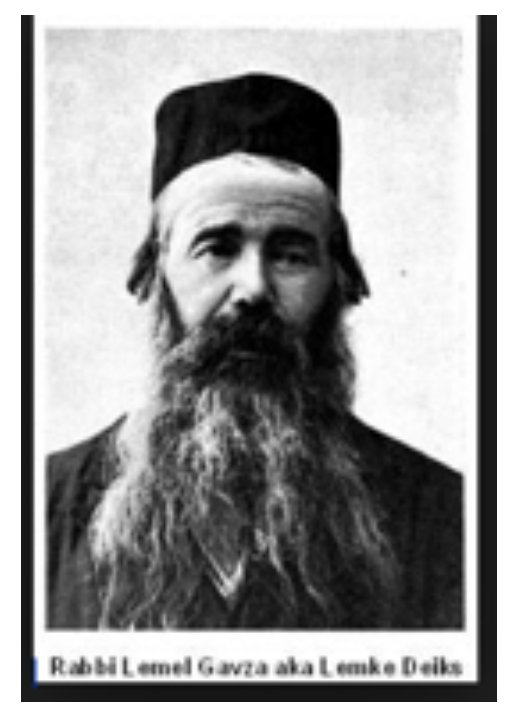
Hayuta Gavsu was from a very prominent Hassidic Jewish family in Lyakhovichi. Her father, Aaron Lemel Gavsu was a Stolin Rabbi, a Hasidic dynasty that originated in the mid 18th century in Belarus, then Lithuania. Here is a picture of Aaron Lemel, Hayuta’s father:
Because Joseph and Hayuta and Eva and Esther all grew up in Lyakhovichi at roughly the same time, and because Hayuta’s father, like the father of Esther and Eva were rabbis in the village, the children were likely to have known one another. But were the two pairs related? Several descendants of our Busel family who have been working on our family”s genealogy have been asking this question for a number of years.
Our first cousin Nancy Felson Brant sent Steve Felson on a mission in Israel sometime between 1970 and 1984. His task was to contact and meet up with a descendant of Joseph and Hayuta Busel to determine if or how our two families were related. Steve remembers meeting someone, probably Hadassah Busel Vardi, Joseph and Hayuta’s daughter and only child. She did not know whether our two families were related or whether they knew one another in Lyakhovichi.
Here is a letter that Hadassah wrote Steve in 1973:
I am the only daughter of Joseph Busel, born in Lachowicze, who was one of the founders of Degania Aleph. As you know, my father drowned in the Kinneret in 1919, when I was 6 months old. My mother did not remarry and kept the name of Busel all her life. She died two years ago.
The sister of my father, Sarah Busel-Giladi, lived in Degania Beth. She died nine years ago. Ruth and Joseph and their families live on Degania Beth.
In 1914 my father brought his mother (my grandmother, Esther Busel), to Israel. At the same time came his sister Pessiah, who was deaf and dumb. They lived in Tiberias and in 1937 went to live on Degania Beth.
To my knowledge my grandmother Esther was widowed at an early age and had six children. The oldest daughter, Feigle, was in the U.S. in South Bend, Indiana. She had 5 children and many grandchildren — we correspond with them. Sometimes the younger ones visit in Israel.
The second daughter, Rivka, stayed in Russia. Her daughter Tsipora (Feigle) came to Israel in 1927 and died here this year. Her two daughters and their families survived her. One is in Kfar Warburg (a moshav in the south) and second in Be’er-Sheva.
The oldest son, Ya’acov (Jacob) lived with his family in Kalek, a small town near Lachowicze. His daughter Sarah has lived in Israel since 1930; she is now at Kfar Warburg.
And my father Joseph (Yosef), Sarah, and Pessiah were here in Israel at Degnia Aleph and Beth, here in the Jordan Valley.
In 1948 a young man immigrated to Israel who had been with the partisans in the Second World War, named Paretz Busel. He remembered that my father Joseph Busel had been a relative of his. He now lives in Be’er-Sheva. The relationship between us is not known.
I’m sorry that we don’t know much on the history of the Busel family.
There are relatives in Chile, but it is unclear how they are related….
Hadassah Busel-Vardi
Another Busel descendant is an Israeli, Niv Schwarz. Niv descends from Meier Busel, brother to our great grandfather Benis.
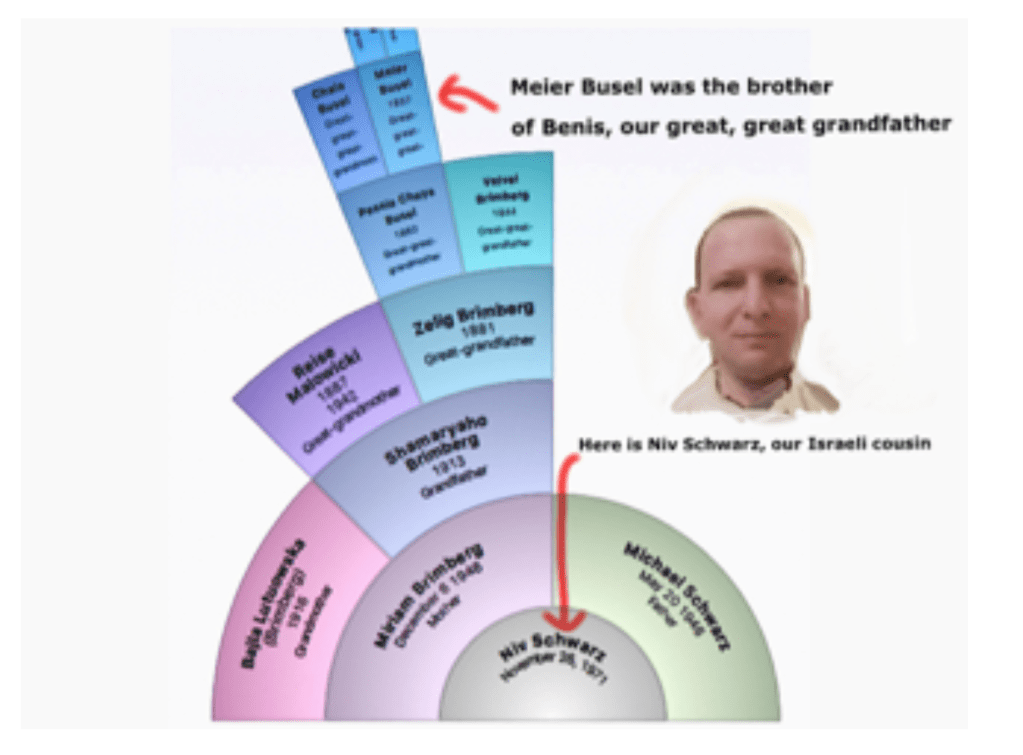
Niv has been looking through Israeli records seeking a relationship between the two Busel families, Joseph’s and ours, to no avail. Here is what he wrote me recently in response to my question about whether he (and we) are related to Joseph Busel:
I’m not related to Yosef Busel the founder of Degania. Me my self try for sometime to find the family relationship/connection.
B.t.w, Yosef’s great grandson is a reporter on channel 10 (Moav Vardi, son of Yosi (Yosef) Vardi the former head of Jordan Vallie Council).
I try to look for Busels at Yad VaShem, with no success. Unfortunately the 2 elders of the family (82 and 94) not familiar with the Busel family.
I have donated money to one of the projects in the Belarus web site which I believe make some light on questions I have.
Niv Schwarz (Shadmot Dvora, Israel)
So, were Esther, Eva, Joseph and Hayuta related? My best guess, based on the evidence at this point, is that our family members Esther and Eva Busel knew Joseph and Hayuta Busel in Lyakhovichi when they were growing up, but that the two families were not blood related.
But, Beth Casey differs! She is hopeful that we will still find the connection through the Busel and Gavza women. For example, she wonders whether Nechama Busel, whose mother was a Gavza (Sterel) and father was a Bushel (Noah Lieb), may have had a blood relationship with our great grandmother Hannah Sarah. Here is what Beth asks:
I’m wondering if Benis’ wife Hannah Sara might be the person related to Nechama, and who is the connection with our family or it could be Rochla who was married to Feivel.
Here is a picture of Stiril Busel Gavza and her extended family that Beth is theorizing about. The granddaughters in the picture may be Nechama’s children.

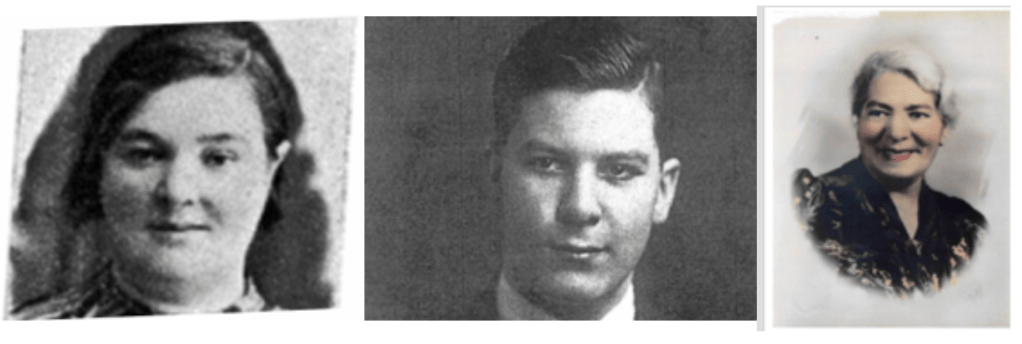
And Beth points to a striking resemblance between Nechama (left), a young Ben Felson (middle), and Esther Busel Felson (right), as a possible indication of the two families being related:
Not all Busels left Lyakhovichi at the end of the 19th century. Niv Schwarz has traced six generations of descendants of his great great grandmother Pessia Chaya Busel who was born around 1860. She was our grandmother Esther’s first cousin. I’ve added her to Nancy Brant’s family tree that she created in 2001:

Pessia married Velvel Brimberg and they had eight children, three boys and five girls. All were born in the area of Lyakhovichi.
I was horrified to learn from Niv Schwarz’s genealogy that twenty-five members of this side of the family, including Pessia and Velvel and their children and grandchildren probably perished in the holocaust in 1941 or 1942. They were among the five thousand Jews who died in three massacres of Jews (called Aktions) in Lyakhovichi in those two years.
Here is a description from the Jewish Encyclopedia of what must have happened to our relatives in Lyakhovichi during those two years:
On the eve of the German occupation (June 24, 1941) the community consisted of 6,000 Jews. The Germans entered town on June 26, and on June 28 a number of Jewish community leaders were murdered in the nearby forest, following which a pogrom broke out in which 82 Jews were killed (July 1). In fall 1941 the Jews were ordered to assemble in the marketplace, where a Selektion was made to separate the 1,500 able-bodied from the 2,000 “nonproductive.” The latter were taken to a trench and murdered; some tried to escape but most of these were shot. The “productive” persons were interned in a ghetto. A group of young persons, led by Zalman Rabinowicz, Josef Peker, and Haim Abramowicz, organized resistance units. On June 10, 1942, a second Aktion was carried out in which 1,200 Jews were murdered. Some attempts at resistance were then made. When an Aktion to liquidate the entire ghetto was carried out the Germans met with armed resistance. Some ghetto inmates escaped to the forests and joined the partisans, among them Shmuel Mordkowski, who was an outstanding resistance fighter. The rest were killed on June 24, 1942. Fewer than ten Jews survived in Lyakhovichi. About 80 Jews from the town who had joined the Soviet army in 1941 also survived.
Linked below are some eyewitness accounts of what happened in Lyakhovichi during the holocaust, discovered on the web by cousin Beth Casey: https://kehilalinks.jewishgen.org/Lyakhovichi/holocaust/infoStories/index.html
It is a fair guess that those in Pessia Chaya Busel and Velvel Brimberg’s family must have been murdered. The assumption about their murders is based upon information provided in the genealogy of Niv Schwarz tracing his family history. These are the people whose death dates (1941 and 1942) and the place of their death (in or around Lyakhovichi) coincide with the Aktions described above.
- Chana Brimberg, wife of a man named Zochowicki, died at age 35 (not clear when or where her husband died)
- Reise Malowicki Brimberg, Zelig Brimberg’s wife, died at age 45
- Risha Brimberg, daughter of Zelig and Reise Brimberg, died at age 22 years
- Sara Brimberg, wife of Alter Meyer Brimberg died at age 56 (not clear when or where Alter Meyer died)
- Chana Brimberg, daughter of Alter Meyer and Sara Brimberg, died at age 42
- Feiwel Israelewitz, husband of Chana Brimberg died at age 44
- Chana Israelweitz, daughter of Feivel and Chana Israelewitz died at age 2
- Another of Feivel and Chana Israelewitz’s children (no name indicated) died at age 4
- Malke Brimberg, daughter of Alter Meyer and Sara Brimberg and wife of Szaya Jurkiewicz (not clear when or where Szya died). Malke died at age 38
- Hiam Jurkiewicz, son of Malke and Szaya Jurkiewicz, died at age 12
- Noach Jurkiewicz son of Malke and Szaya Jurkiewicz, died at age 14
- Pnina, daughter of Malke and Szaya Jurkiewicz, died at age 16
- Solomon Brimberg, son of Alter Meyer and Sara Brimberg, died at 37
- Miriam Brimberg, wife of Selig Litowski, died at age 51
- Selig Litowski, Miriam’s husband, died at age 46
- Israel Litowski, son of Miriam and Selig Litowski, died at age 16
- Noah Litowski, son of Miriam and Selig Litowski died at age 20
- Luba Litowski, daughter of Miriam and Selig Litowski, died at age 22
- Sara Strelowski, wife of Itschak Aaron Brimberg, died at age 37
- Wife Brimberg?, daughter of Sara and Itschak Brimberg, died at age 15
- Henya Brimberg, daughter of Sara and Itschak Brimberg, died at age 17
- Dora Brimberg, daughter of Sara and Itschak Brimberg, died at age 18
- Chana Brimberg, wife of Joseph Strug (Strugatch), died at age 39
- Joseph Strug, husband of Chana Brimberg, died at age 41
- Nohach Strub, son of Joseph and Chana Strug, died at age 17
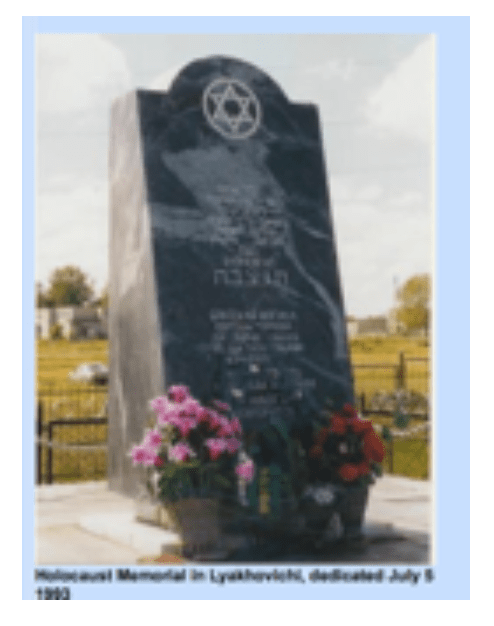
All my life I’ve regarded the holocaust deaths as happening in other peoples’ families, not my own.. Not so. There are at least 25 family relatives from Pessia Chaya’s branch alone. Here is a memorial to those in Lyakhovichi who were killed in the holocaust:
Another branch of our family tree stems not from Pessia Chaya, but from her brother Benis (Benjamin). Benis, too, was born in Lyachovichi. He, like Pessia Chaya Busel, was Esther and Eva’s first cousin.
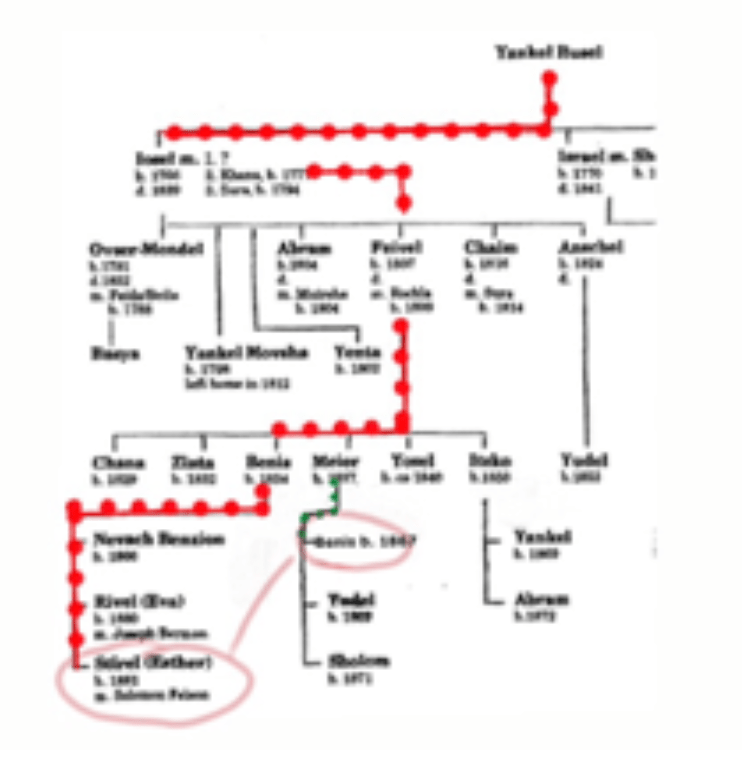
Benis Busel and his wife, Fanny Berkowitz (b. 1887), had seven children all born in a shtetl near Lyakhovichi, called Romanivo. Benis and Fanny emigrated to the US before the second world war, as did at least three of his children.
One of Benis and Fanny’s children, their oldest son Harry Bushel (b. 1888), moved to New York City in 1907. I have been in touch with a descendant of his, Caroline Judith Bushel (b. 1983). Caroline is a genealogist who has traced Benis and Fanny Bushel’s
family. Caroline’s tree shows that two of their children, Chana and Label, probably died in Belarus in 1942. I am presuming that they, like the 25 people in Pessia Chaya’s family, were killed by the invading Germans and their collaborators. That brings our family’s total known losses to 27 people. There may be more. For example, Caroline only accounts for five of Benis and Fanny’s children. She doesn’t record what happened to the other two.
Here is our newfound cousin, Caroline Bushel whose branch, like ours, survived those terrible times because the US opened its doors to Lyakhovichi emigres, some forty years before the holocaust.