1874-1934
Born in poverty in 1874 in Dvinsk, a province of Vitebsk, Russia. Left home at 8 years (father died, mother remarried, stepfather ogre). Taken in by a Yeshiva. He later became a tailor, working as an apprentice to his mother’s brother. Became a political activist. Married Esther Busel in 1901. Emigrated to US in 1902, eventually ending up in Newport, Kentucky. Set up a tailor shop in Newport and then to several other places in Kentucky and Ohio. His shops were community gathering places for political discussions. Was an active member of the socialist Workman’s Circle. Sol and Esther had nine children. He died of a heart attack in 1934.
Biography
Solomon Felson was born in 1874 in Dvinsk in the province of Vitebsk, Russia. His father was a rabbi, his mother a Hebrew teacher. He lost all five of his siblings to poverty. After Sol’s father died of pneumonia at the age of 33, his mother remarried a widower who had several children. Sol was forced by his step-father to leave home when he was 8 or 9. His mother had a another child, Nechama with her second husband. Shortly after Nechama was born, Sol’s mother died.
Sol was taken in by a Yeshiva, but not given enough to eat. Because of that and because he educated himself to learn Yiddish, something not allowed by his Yeshiva, he was “turned out” and forced to make it on his own. He began learning a trade, first cap making then tailoring. He worked as an apprentice tailor for his mother’s brother.
When he was in his 20s, Sol became a political activist giving public speeches against the government. This was during the time when the Jewish bund was being formed in Russia to give Jewish workers a voice and build a more egalitarian society. The bund was formed in 1897, in response to the repressive and anti-semitic Russian czarist regime.
Sol met Esther in Warsaw at a political event. They married in 1901 when Sol was 27. His political activities placed them in jeopardy, or, as he described it “conditions of living were miserable” so he decided to leave the country and look for a better life in America. Another reason he might have left Russia was to avoid the military draft.
Upon his arrival in the US in 1902, Sol first stayed in New York City. “Thinking that he could do better in a smaller city”, Sol went to the Industrial Removal Office of the Jewish Agricultural Society in New York City in search of a new place to live. They sent him to Cincinnati, Ohio on May 20, 1903. He had a skill, tailoring, and the “removal” was based on that. He moved to the Cincinnati area (Newport, Kentucky). Once he had found a place to live in Newport, (331 West 6th Street), and had saved a little money, he sent for Esther and their two young children.
Esther arrived in 1904 with her daughter Sophie and son Irv. In Sol’s words: “Out of my pay I sent three dollars back to my home in Russia, three dollars I lived on, and the rest I saved until I was able to send for my wife, daughter, and a son that I had never seen.” His income was based on a business he owned that he called a “second hand shop” and also as a tailor shop.
Here is a description of how things might have been in Newport for an immigrant tailor such as Solomon Felson:
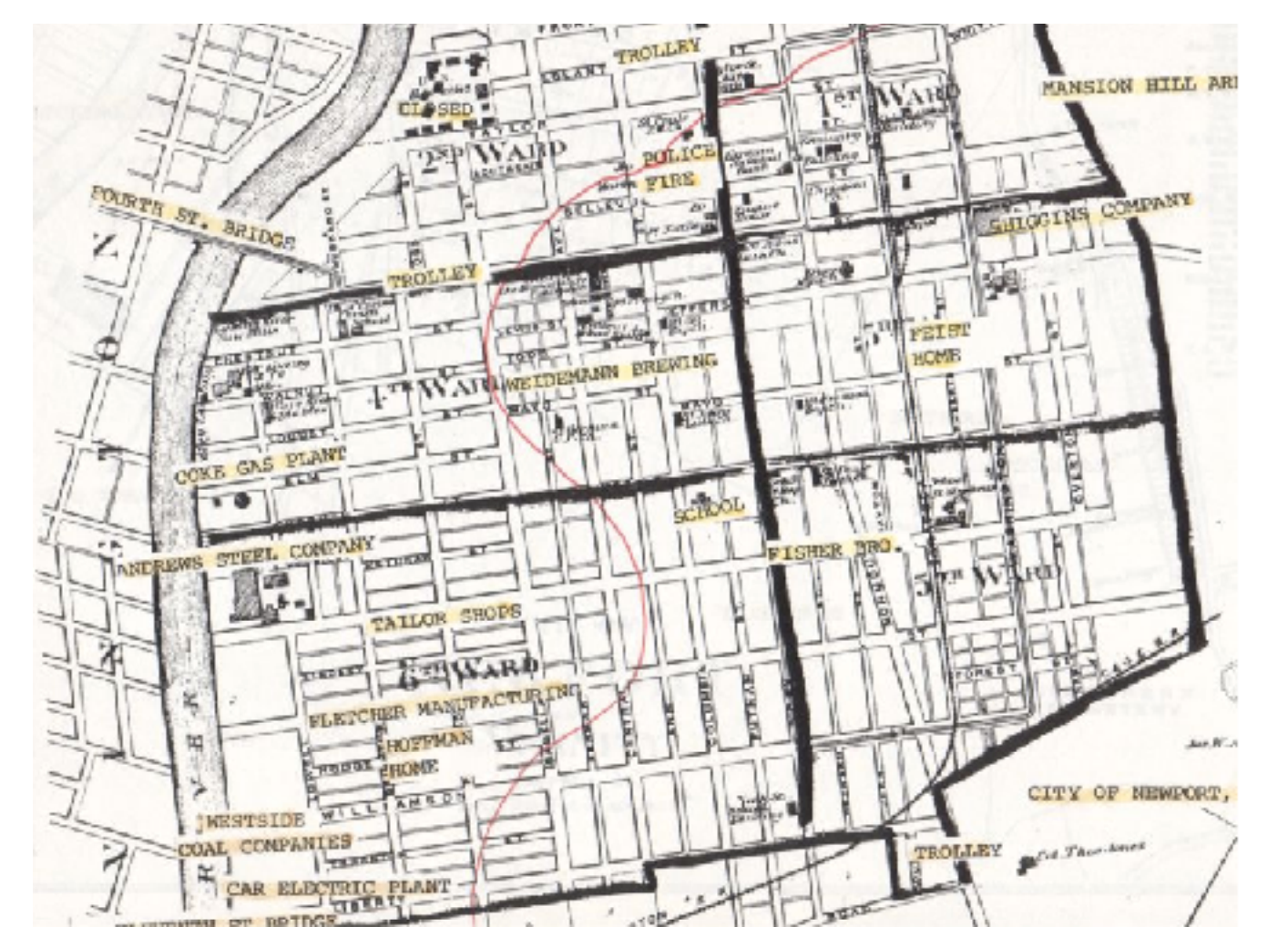
People talked about working for the tailor shops in Newport. Most were sweat shops and paid workers as piece goods were done—1 cent for button holes, 2 cents a pocket, and 3 cents a lapel. Shops had pot-belly stoves in winter and only the favorites got to sit next to the stoves (Bauer, D. 1988, Floods to floodwalls in Newport KY, 1884-1951. masters thesis, Xavier University).
Daniel Bauer showed a particular area of Newport in which the tailor shops were located:
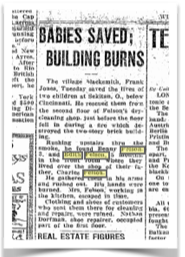
Later Sol opened other tailor shops. He moved his shop several times over the next 30 years. Some of the moves were financially motivated (he was avoiding paying rent). He moved from Newport in 1913 to Carthage, Ohio, and then, to Addyston, Ohio in 1915. He moved from Addyston to Cincinnati because of a devastating fire in 1915 that burned down his place of business as well as the family living quarters. The fire was reported in the Cincinnati Post of November 24, 1915:
Sol worked as a tailor until his premature death in 1934 at age 52. From 1915 on Sol also offered dry cleaning services and sold second hand clothing in his tailor shop.
The tailor stores Sol opened were listed either in the clothing or tailoring sections of the city directory. His shops were known by his customers as places where people could bring letters and documents written in Yiddish and have them translated into English.
Sol continued his political work in Cincinnati, working on behalf of the Workman’s Circle, a Jewish socialist group.
Sol’s longest stay in one workplace was at 1407 Central Avenue, a short walk from his family residence at 401 Hopkins St. The Cincinnati City Directories of 1917 to 1923 show Solomon Felson in this 1407 Central Avenue location.
In 1927 Sol relayed his early life story to Edith so she could fulfill a project assignment in her sixth grade class. The story was subsequently published in the Walnut Hills school newspaper.
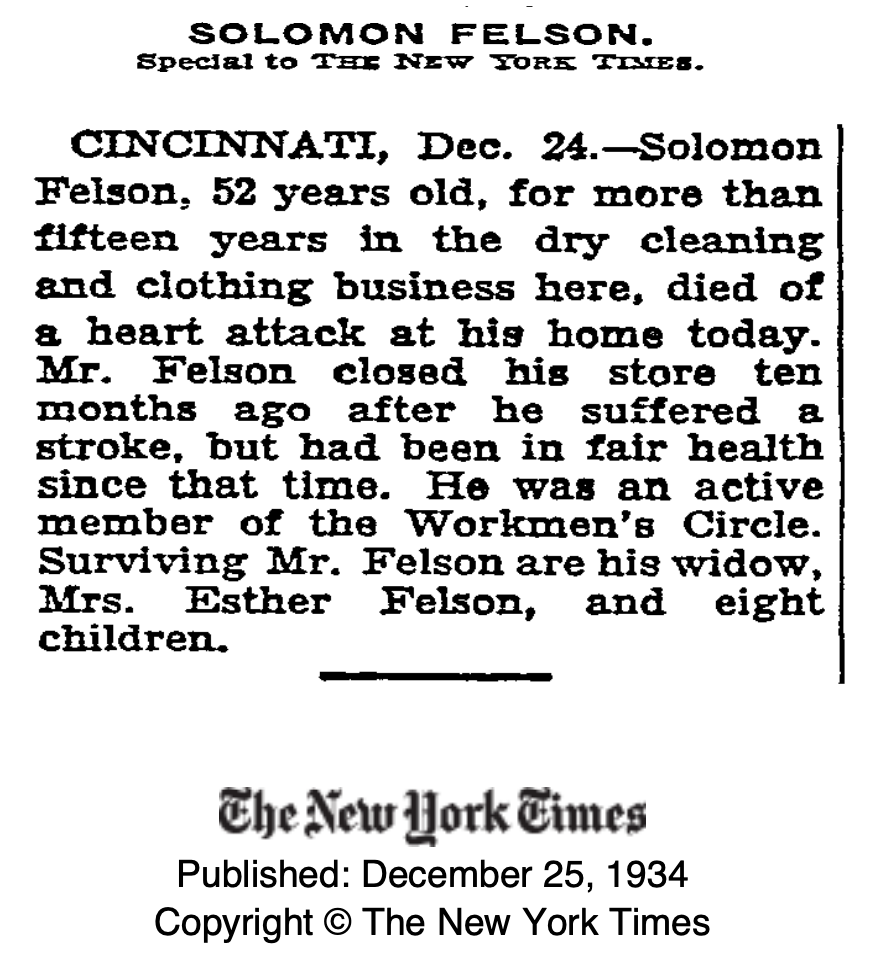
Sol died of a heart attack on December 24, 1934. His obituary in the New York Times read as follows:
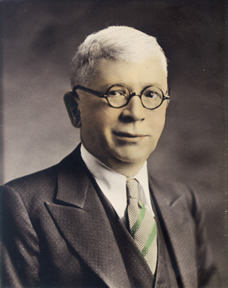
 The Felson Family