Nancy Felson and Judy Felson Duchan’s Recollections of Our Life Together
October 4, 2026
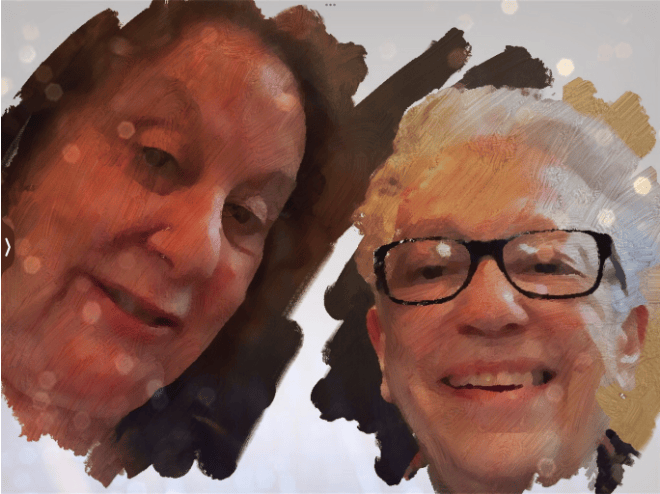
We have written this letter to help us remember and valorize our lifetime together, a victory ode of sorts. As we realized in a recent phone conversation, it would be more meaningful for us to create our mutual history rather than to write separate appreciation letters. One of the things we so value in our relationship is our ability to work together to reflect on life’s puzzles. So, we thought together, why not carry our predilection to collaborate into a combined legacy letter to one another?
Maybe our relationship began before we were born. Our fathers, brothers, had a fraught relationship in their childhood, so the family story goes. Walter, the “big brother”, may have bullied Ben. This came from Ben’s children’s stories, not Walter’s. Later in life, after Ben had made a name for himself in his field of radiology, Walter often bragged to those who would listen about his brother’s fame. Ben’s fame was also Felson fame, in Walter’s eyes.
It is not clear to us, looking back now that we are in our 80s, how this possibly fraught childhood relationship between our fathers played out in their adult lives or in the lives of their progeny. Maybe our fathers’ relationship impacted ours, maybe not.
Our mothers were also “frenenemies”. They kept in close contact over the years, but their friendship wasn’t always easy. Roslyn, Judy’s mother, was conflicted about Ginny’s laissez faire mothering style. Was she, Ros, too involved with her children (sometimes she cast her mothering style as “worrying too much”) or was Ginny too relaxed in her motherhood role? Here is a snippet of a letter from Ros to Walter about her ambivalence about Ginny:
She said Stevie is to be operated for his hernia next week, but Ginny isn’t very concerned about it. She wouldn’t be. If that were me — I can just imagine! Maybe I’m wrong (January 11, 1944).
And Ginny, in turn, may have felt that Ros was too prescriptive as a mother. One of her favorite stories to Judy involved her description of how Ros did not accept Elaine’s marriage, at first. Ginny on a number of occasions described to me (Judy) a baby shower she held for for Elaine, Ros’s daughter, as if to say that she was more “broadminded”, more accepting as a parent than my mother was. Nancy’s take on this story is that Ginny was being philosophical and accepting, and modern. She was not intending to insult Ros.
Despite stories of family conflict, such as the alleged “big brother” bossiness of Walter directed to Ben, it seems to us that the eight children of Sol and Esther Felson were unusually close throughout their lives. As a result, we cousins knew our aunts and uncles and one another very well. Most of our frequent visits with each other’s families during our childhood took place in Cincinnati, in the three homes of Nancy’s parents, Ben and Ginny, the first on Dickson Avenue the second on North Crescent and the last on Rose Hill. Those visits were punctuated by buffet dinners prepared by members of the family, particularly Sophie. Nancy’s mother Virginia and Fanny, her African American sidekick organized and served for the events. Or was Ginny the sidekick? There were also occasional visits to Greenfield by Nancy, sometimes with her family, more often by herself. Nancy remembers traveling for 1 1/2 hours by train as a very young child. (Was Ginny being too lenient when letting her daughter travel alone?)
Then there were the war years. Our fathers, as well as two other Felson brothers Leo and Chippy, enlisted in the second world war, shortly after Pearl Harbor. The Felson siblings and their spouses kept in close touch during those years, visiting one another before the soldiers went overseas, and writing one another throughout the war (especially from 1944-1945). Here is a paragraph of a war letter from Ros to Walter describing how they all kept in touch:
I called the family in Cincy to tell them I heard from you, and Irv said that Ginny had also received a cable from Ben. So now, more than ever, we are drawing conclusions that you were both in the same convoy. I hope, for your sake that you both have met and can keep in contact with each other. It would be wonderful (Jan 5, 1944).
Ben and Walter never met up in Europe, though they remained in contact through letters, especially Walter’s. Here is Ben’s comment about Walter’s famously detailed war letters written on March 10, 1944 (click to read more of Walter’s letters).
Also I am still receiving fascinating letters from Walter in North Africa. I should certainly like to see him. He seems to have changed a lot. Imagine Walt joining our liberal ranks!
Note: Our two families frequently bantered about their political differences, with Judy’s parents being more conservative that Nancy’s. Judy remembers her mother castigating Virginia for reading PM, a left wing newspaper.
We, Judy and Nancy, went our separate ways during our college years and during Nancy’s child rearing years. Judy hardly knew Nancy’s husband Roderich Walter or their young children. Nor did she keep track of what was going on with Nancy when she was married to Paul Rubin. And Nancy didn’t know Judy’s husband Alan Duchan very well at that point. We saw one another at the occasional family reunion…but were not in one another’s lives. It was all we could do to keep track of our own lives during that busy time!
We didn’t reconnect until 1984 when Nancy attended a NEH sponsored summer seminar in Buffalo taught by our mutual friend Jack Peradotto. Jack was a classicist at Judy’s school, The University at Buffalo. Nancy and Judy hung out together that month in Buffalo and found we had strikingly similar academic interests. We were both using linguistic-based frameworks to reveal and understand phenomena in our very separate professions—Judy’s was speech pathology, Nancy’s classics. We talked about technical issues in our fields of language study: semiotics, deixis, narrative analysis. Nancy gave a talk on Telemachus’s adolescence to Judy’s cognitive science research group. She then read Judy’s group’s research on deixis (see here) and created her own research program on that topic (see here, for example). Thus began our regular and frequent discussions about life in general and our lives in particular; about our research; and about our beloved Felson family. What fun having so much to talk about with a first cousin.
We started a few family-centered projects together. Nancy wrote pieces about her nuclear family for Judy’s family website. (That website is now under the wing of next generation of the Felson family: Amy Travis, Eric Vanzant, and Jake Felson.) And we created legacy appreciation projects to celebrate the life of Virginia Felson and Jake Raphaelson, Nancy’s mother and grandfather. We also met over the family archive of Nancy Brant after her death to sequester and preserve material she had gathered on Felson genealogy. Some of our projects did not materialize. We did not pull off a suggested family conference to talk about why our generation of Felsons were so success-oriented. Nor did we find enough about the personal lives of the mothers of Sol Felson or Jake Raphaelson to have that hoped-for project grow into something tangible.
We met up in New York City a number of times, sometimes staying at the downtown apartment of Nancy’s daughter Sabrina. We also met up in Athens Greece once, just in passing; in Buffalo, New York a few times, where Judy now lives; in Athens; Georgia where Nancy lived; and in Chatham and Hudson New York, where Nancy summered. Nancy joined the Walter Felson thanksgiving reunions on occasion, both at Turkey Run State Park in Indiana and at Heuston Woods in Ohio. We did what we could both before and after we retired to stay in close touch.
We have loved our multifaceted relationship, as cousins, as scholars, as fellow travelers in all senses of that word. Thanks go to you, dear cousin, for enriching my life; for making it less ordinary and less odious (excuse the play on the word ode).
With love and gratitude to each other for all these precious times together,
Love—and thanks for the ride,
Judy and Nancy

