(Aug 14, 1915—Feb 6, 2003)
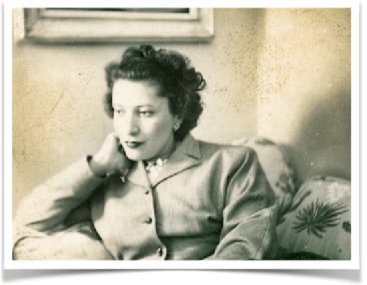
Born in Addyston, Ohio in 1915, the eighth of nine children of Esther and Solomon Felson. At five months she and her older sibling Ben were saved from a fire by a village blacksmith. At five years she moved out of her family home in Cincinnati and down the street to live with a wealthy family, the Nickles (two sisters and a brother). Attended Cincinnati’s Walnut Hills High School between 1927-1933. Lived with her mother and siblings during the depression. Worked as office secretary to several Cincinnati physicians. Also did volunteer work at the Jewish Center teaching refugees English during WW II. Had a doll collection. Married at age 51 to Mickey Raphael Shapiro in 1966. Mickey died three years later in 1969 at age 60.
On August 14, 1915 Edith Felson was born into the Solomon and Esther Felson family, becoming the eighth of what was to be nine children. Her parents had emigrated to theUnited States from Russia a little over ten years earlier, settling in the midwest where jobs for tailors were more plentiful. The family had been living at 331 West Sixth Street in Newport, Kentucky for ten years before Edith was born.
The Felson family moved from Newport around 1914. They ended up in Cincinnati, Ohio a couple of years later. But in between, they may have moved to Gallia, Ohio, to Carthage, Ohio and then to Addyston, Ohio. This is evidenced in Edie’s place of birth as being listed in the 1920 census as Gallia, Ohio. In Addyston the family moved into a two story brick house on Sekitan Avenue. Sol located his own tailor shop on the first floor, sharing that floor with Nathan Dorfman’s shoe shop. The Felson family lived upstairs.
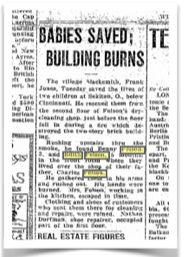
A few months after Edie was born there was a terrible fire in the brick building. The Cincinnati Post of November 24, 1915 reports the building burning under the headline Babies Saved, Building Burns. The article describes the fire that burned down the brick building containing Felson’s dry cleaning shop. “A village blacksmith saved two children, Benny Felson, age 3 and Edith Felson, age 5 months. The family lived above the shop.” The other children must have been in school at the time. Julie remembers Louise being called out from her classroom to the principal’s office to tell her that her house had burned down.
Eventually Sol and Esther did settle in Cincinnati, along with baby Edie and six other children (three-year-old Nathan had died of diphtheria two years earlier). Their first Cincinnati address was 410 Hopkins Street. Their neighborhood in the West End of Cincinnati was mostly poor. Solomon rented a storefront a few blocks away from home at 1407 Central Avenue where he sold his wares and services as a tailor. His work establishment was sometimes listed in the city directory under tailors and other times under clothing shops.
Also near the Hopkins Avenue house was the home of a family named Nickles. Shortly before the Felsons moved into the neighborhood the elder Nickles, Sam and Caroline, died. Sam Nickles, the patriarch, died in 1908 and Caroline, his second wife, died in 1913. Sam had been a well established physician, university teacher (of chemistry), and medical author. He Caroline had had four children living with them, two from Sam’s first marriage (his first wife Alice died in 1869) and two from his marriage with Caroline, whom he wed in 1871. Prior to their death, according to the 1910 census, Sam and Caroline were living alone in the big house at 1406 John Street.
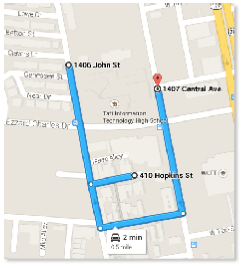
By the time the Felsons moved into the neighborhood in 1915, three of the Nickles grown children had moved back into their family house. Alice, age 54 in 1915, was from Sam’s first marriage. Martha (age 35), and Samuel Jr. (age 30) were Caroline and Sam’s children. Alice was an artist, Martha a school teacher, and Sam Junior was an engineer.
When Edie was five or so, arrangements were made to have her move in with the Nickles at their John Street house. No one now knows why or for how long Edie lived there, but what is known is that her stay with the Nickles had a significant impact on her and her siblings, then and later, after the children were grown. Edie’s time with the Nickles also figured significantly in how the next generation of Felson family members construed and understood Edie’s history and her place in the Felson family.
Some of the second generation Felsons were distraught that their grandparents, no matter how poor, would let one of their children live elsewhere. Others took a more positive view, seeing Sol and Esther’s willingness to let Edie live with the Nickles as seizing an opportunity—she had nice clothes, was able to travel with the Nickles sisters, and was given lots of attention. Edie and her sister Louise both talked on separate occasions about the jealousy between them when Edie would come to the Felsons dressed in expensive clothes that the Felson family could not afford.
This is Virginia’s Felson’s take on Edie’s time with the Nickles family, written in 2003, upon Edie’s death:
Why did Edie spend so much time at the Nickles’ home? It seemed the ladies saw this beautiful little girl, invited her into their home, introduced her to music and art –they were both artists—and began giving her gifts, buying her clothes, taking her to concerts. They seduced her. Even sent her to Europe and took her on other trips. When they asked if they could adopt her, her parents realized what was happening and tried to forbid her from going. It was too late! I remember Louise saying that she felt like a poor relation. Edie would come home in lovely clothes and Louise, a 16 year old, was poor and jealous. Edie learned to love beautiful things. She always was well groomed, had nails and hair done!
And Lois Mock attributes Edie’s later extraordinary attachment to the Felson family to this period where she felt as an outsider:
I remember Aunt Edie saying that she walked over to the Felsons’ house frequently to see her family. But she felt like somewhat of an outsider even so. She was dressed more expensively and had opportunities her siblings didn’t have–to travel, piano lessons, cultural things. And she never got over the feeling that her parents had “forsaken” her when they permitted her (encouraged her?) to live with the Nichols’. I think she would have been happier to have just shared the Felson life and felt one with her family. Despite that, she was still grateful for the advantages she was afforded and the things she learned and saw. But I think the Nichols’ sojourn was at the base of her strong loyalty to the Felson family all her life and her devotion to all of us. It was so important to her that she be “one of the family.”
Places in Cincinnati where Edie lived over the years
In 1927, when the Felsons moved out of the West End of Cincinnati, Edie moved with them. She is listed as part of the Felson household in the 1930 census when the family lived at 3323 Reading Road. She continued to live with her mother and siblings after her father died in 1934 and moved with the remaining Felsons to 826 Glenwood Avenue in 1935. In 1938 Edie again moved with her family (Mother, Esther, sister Louise, and brother, Leo) to 956 Burton Avenue. Esther died of heart failure in 1941, and the family dispersed.
Later residences for Edie listed in the city directory include:
- With Irv and Rosalyn: Edie lived on the third floor of Irv and Rosalyn’s house in 1943. Letter from Leo to family on December 18, 1943 reveals Edie’s plan. To Irv: “I was glad to read that Edie is going to use your third floor room.”
- 424 Forest Avenue, Apt 5 (city directory, 1951)
- 994 Dana Avenue, Apt. 5. (city directory, 1956, 1960)
- Lux Edgecliff Condo at 2200 Victory Parkway. Lois also remembers Edie living in Vernon Manor, 400 Oak Street,before she married Mickey.
Edie was married to Micky Raphael Shapiro in 1966. For three years, until his premature death at age 60, they lived together at 3896 Reading Road Apartment G, and in the Belvedere Apartments, at 3904 Rose Hill Avenue.

Edie continued living in this beautiful building after Mickey died.
Later, she moved to various places. Ginny remembers that Edie lived once with Ruth Steiner as a companion—a wealthy, cultured lady with a beautiful home; had a housecleaner and a cook. Edie loved living with her. One day Mrs. Steiner came over and said, “Edith can’t do anything.” She wanted to fire her. I said, “Ruth, you’re getting older; you might need a companion.” She didn’t fire Edie.
In her later years, after repeated suicide attempts and difficulties with walking, Edie lived in assisted living facilities. Lois remembers one of the facilities as follows: She had a little room of her own, with a few pieces of small furniture and some of her nice things. However, things began to “go missing” so a lot was stolen. She moved from that facility (maybe because of the theft? Maybe cost?).
The Cincinnati City Directory of 1989 lists Edie as living in the Philada Apartments 7732 Greenland Place. Chippy has her living there in 1991.
Her last home was in a Jewish Family Service facility, Cedar Village. Lois, again:
She had a small room and ate her meals in the general dining area until she got too ill. It was not a fancy place. We cousins paid $300 per year for multiple years so that she could stay there, since she had no funds of her own.
Edie’s schooling
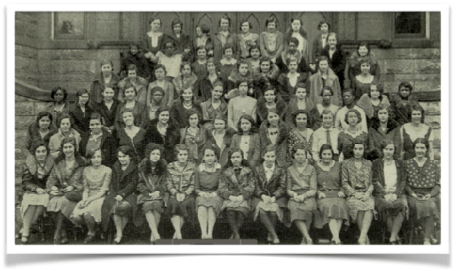
Edie attended Walnut Hills High School from 1927 to 1933. The high school is a six year college preparatory school. In 1927, the year Edie entered the school, she worked on a sixth grade school project in which she interviewed her father about his life. Her write-up was published in the school paper and became significant piece of history that the family later used to understand Sol’s background. Below is a photo of Edie with her Walnut Hills class. She is in the first row at the left.
Edie’s Relationship with her Nieces
Edie was very much in the lives of her nieces. She regularly made the hour and a half trip to Greenfield, Ohio to visit her nieces Judy and Elaine. This was particularly true during the war years 1944-1945, when Walter, Edie’s brother, was overseas and Roslyn was home in Greenfield with her two children.
Edie also lived with Irv and Rosalyn for a while, getting to know their daughter Nancy. (Alan was born later.)
Edie also was a regular visitor to Chicago where she maintained a close relationship to her nieces Julie and Beth Abramson. She even lived for a year with her sister Louise and brother-in-law David Abramson, during which time she became part of the nuclear family of Julie and Beth. She often spent Friday night seders at Chippy and Helen’s house interacting with Lois and Jane.
When Edie died, her nieces wrote their reminiscences of Edie. Several wrote about Edie doting on them and serving as their “second mother”. We all looked forward to the gifts and birthday cards. Several also appreciated what they saw as her exotic and beautiful life style (“the beauty of the family”; she had exotic friends such as the Latin ballroom dancers Yvonne, Clavelle, and Ferrer. “How dashing they all were!” “Exotic friends from faraway places” “She had lovely things, including an exquisite doll collection.”
Here are a few of excerpts from her nieces tributes to her at the time of her death in 2003:
Judy on Edie’s attentiveness: She listened, laughed, kept track of where were and what we were doing, sent us presents, and birthday cards. She was more than our aunt, she was our guardian angel. I hope she knew how much we loved her.
Lois on her relationship with Edie beyond childhood: I felt very close to Edie from my teenage years on and always made sure we had our special afternoon or evening together whenever I came home for a visit. There were many long conversations over dinners at restaurants on snowy winter evenings around Christmas time.
Nancy Ruth on her relationship to Edie, later in Edie’s life: I remember asking Edie what it would take for her to be happy. I discovered, in our talks in her home, that she was a deeply reflective person, trampled upon by some events of life but struggling to come to terms with them. A friendship with Edie began in that apartment (Vernon Manor) and continued, though intermittently, till her death. Her desire to integrate the Nickles years within a Felson life led to her wanting to dictate her memoirs (which I regret not ever helping her do).
And Julie has recently reflected on Edie’s sense of humor: It was different from anyone else…mischievous and sometimes self deprecating, also quite sly or sharp about others—but in an appealing and funny way. She was a very intense person. Mark comments: “Her wit was wicked.”
Here is a sampling of Edie’s humor, in a story dictated to Julie on the occasion of David Abramson’s 90th birthday:
One of the funniest days I ever experienced in my life was your wedding day to Louise. I went to NYC to attend your wedding. On the day before, I met Louise who was planning to relax for a day at the beach prior to her wedding. Of course, Louise, who wanted a little color to look her best at her wedding, was very fair and got a terrible sunburn in a very short time. I stayed out of the sun. Since it was really just about the worst thing that could happen to a bride, we both got hysterical.To make matters worse, when we got out the dress she was planning to wear, the sunburn showed bright red through the sheer top. By that time, Louise had a terrible case of herpes all around her mouth. She gamely laughed and said, “aren’t I a beautiful bride.” We kept on laughing all day as things went from bad to worse.
Edie’s health
Throughout her life Edie was treated as emotionally fragile by her siblings and in need of supervision and protection. In her mid 20s, when she was looking for a vocation in nursing, her family (especially her older brothers) advised her against it, arguing that she wasn’t healthy enough to withstand the rigors of the training. They also were said to be concerned about her being made vulnerable to the advances of doctors. Nurses were considered by them to be “loose” by which they meant sexually promiscuous.
Indeed, Chippy’s long held negative views about nursing transferred to Lois: “When I was seriously considering nursing as a career, he strongly dissuaded me saying that doctors didn’t respect nurses. I got the feeling he looked down on the nursing profession”. This is particularly ironic, since Chippy dated a nurse before he met Helen and wanted to marry her but was discouraged by the family—not just because she was a nurse, but also because she wasn’t Jewish.
Edie’s brothers were cautioned (by their wives and by one another) to watch what they said or how they behaved around Edie—no dirty jokes, no discussion of latrines, keep it clean.
Roslyn reflected on Edie’s medical and emotional history in a long letter to Walter written in August 1944, when Walter was in the army. Here she talks about being the care of two different psychiatrists, a Dr. North and Dr. Harry Salzer and of having been (incorrectly) diagnosed with multiple sclerosis at one point:
You remember the great emotional upheaval she went thru several years ago when she went to work with Wigser. Well, she tells me that Wigser sent her to Dr. North, whom she would see once a week over a long period and he really did some excellent psychotherapy on her. She gives him credit for bringing her out of that abnormal—thwarted and sheltered life that she had been living in under the influence of Miss Nickles. Really, the poor kid’s entire younger life was one of many conflicts and its surprising that she came out of it as well as she has.
Ros also believed that coming home and having Louise’s influence over her brought her out of that immature and abnormal world she was living in. Of course Louise was at the other extreme and Edie said she certainly shocked her plenty at the time.
Edie also admitted she had no feeling whatsoever about her mother and her death phased her not at all so that then caused her to have guilt feelings — which Harry Salzer helped dispel.She admits she had a father fixation too. She really has had a complicated young life, and if you ask me, is still not free of many conflicts.
She admits she read her record at Harry Salzer’s office getting the diagnosis of multiple sclerosis and disseminating sclerosis. I told her not to take it too literally, since they weren’t sure and the symptoms were so atypical and their predictions hadn’t panned out. I do believe this worries her altho she puts on a good front. She has been taking Benzedrine for a long period that she says was prescribed by Armig? She claims that this keeps her pepped up and without it she becomes very depressed. Her eyesight is very poor—with blurred vision and nystagmus and which Harry Salzer diagnosed as retrobulbar neuritis and for which there is absolutely nothing to do.
With all this, the future doesn’t look too good for Edith and perhaps that is why she has adopted the carefree attitude. She really isn’t close enuf to anyone in the family for any guidance.
Roslyn’s sense that Edie did not get the support she needed from her family is also reflected in the comments of Lois who feels that some of her brothers didn’t appreciate Edie: I think Chippy, Walter, and Ben never really respected her as they should have. They felt she was extravagant with money and that she was emotionally unstable.
There were a number of years, especially after Mickey’s death in 1969 that Edie’s mental health was again in jeopardy. She was hospitalized several times in her later years for attempted suicides, and was medicated for depression. Eddie Felson remembers one such occasion after Mickey had died:
I assisted Chippy in reviving Aunt Edie after a suicide attempt. Chip said she didn’t take enough pills to actually kill herself but that this was a call for help. Chip was angry at her. I didn’t understand why and got mad at Chip. He explained that he had been through this several times with her and she had other options. This took place at the Belvedere Apts. on Rose Hill and Clinton Springs where she lived. I don’t remember if she called Chip or a neighbor.
Later in her life Edie’s siblings and nieces and nephews helped her out financially. This involved giving her money as well as managing her financial affairs. At one point, Ben was put in charge of paying her bills and monitoring her spending. Judy remembers her mother Roslyn’s disapproval of Walter’s helping Edie financially, because according to Ros, she was likely to squander it on unnecessary frivolous items such as expensive clothes. Lois remembers the cousins paying $300 a year for multiple years so that Edith could stay in her nursing home.
The Men in Edie’s life
Edie married at 51. Her husband, Micky Raphael Shapiro, was a retired military careerist in the Israeli army. He was visiting his sister in Cincinnati for a few weeks when he met Edie. Edie wrote an essay about first meeting Mickey. They were introduced by Irene Wander, a childhood friend of Edie’s. Today Irene’s nephew is Steve and Ginny’s ophthalmologist. Edie and Micky were married in 1966 at the Rose Hill home of Ben and Ginny Felson.
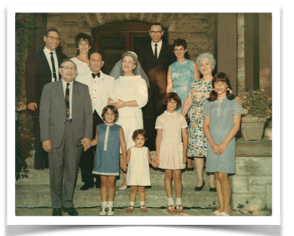
After marrying, Micky and Edie lived together in Belvedere apartments an elegant building at the corner of Reading Road and Clinton Springs. (See above for a picture.)
The nieces and nephews liked Micky. Lois remembers him as being a great story teller, Richie remembers him doing a great imitation of an ape, and Alan Duchan remembers him telling about drinking a Shandy, while in the Israeli Army. Mark says: As a kid I thought he was interesting and neat, but Dad and Chippy did not like or trust him, and he was a kind of storyteller with too much embellishment. I still have fond memories of him, and he made Edie happier so far as I can tell.
Ginny and Ben’s house was the site of Edie and Micky’s wedding as well as the site of Micky’s death. Here’s Ginny on the topic:
Edith was married at our home on Rose Hill. Four of her brothers held up the chuppah. I think she was near fifty. She was a beautiful bride. Three years later. Mickey died at our home on Rose Hill. He and Richie were playing ping pong in the basement. Richie came running up to get us. I remember Ben holding his head up on the kitchen floor. Micky died before he got to the hospital. The ambulance at that time was ill equipped. Ben felt guilty because he thought he should have driven him.
And here is Richie’s recollection of the night Micky died:
He quit ping pong because he felt sick and went upstairs by himself. I came up a bit later and he was lying on the breakfast room floor with my father and others around him. My father did not realize that it was a heart attack. He called Micky’s doctor but the doctor took a while to get there, not knowing how serious it was. The ambulance may have been delayed as well. Mickey died on the way to the hospital.
Afterwards, Edie and my Dad returned to our house. Edie sat in the living room stunned — no tears. My father immediately went into his study to work. I think my father felt guilty (or regret) about not recognizing it was a heart attack and not acting more quickly. He expressed that regret to me soon afterwards. If Chippy was there things may have moved more swiftly: he was more knowledgeable about this condition and more cautious.
Lois remembers what went on with Edie after Mickey’s funeral:
The day of Mickey’s funeral, after the service, Edie’s brothers insisted that she come home with one of them and not return to her apartment. They worried that she might try suicide. I vaguely remember that there was a handgun in the picture (probably Mickey’s) which was confiscated. Edie was devastated. She wanted to return to her home to grieve, etc. She loved that apartment. So I volunteered to return with her and spend the night. We had a lovely evening. We sat around her kitchen table, ate some raw carrots, and talked into the wee hours. I think we were both grateful for that evening and night.
Bob Travis has kept track of Mickey’s relatives since Mickey died. He reports in 2014:
His sister died this year. She was married to Roman Ginsburg. Someone in the Felson family helped him get a job. He had a sister who lived in Roselawn and had 2 children a little older than me. The one I knew was Josepha. She was absolutely stunning. Every now and then I run in to her.
Prior to her meeting and marrying Mickey, Edie had had several other men in her life. In her travel diary, written in 1936, when Edie was touring Europe and Russia, she made frequent mention of a person named Nooky. She reports buying him gifts and writing to him regularly. Who was Nooky?
Ginny remembers a suitor called Al Light: I was living in Tulsa when Al Light was woo- ing her. She was ill. He came over every day. Very brilliant, a little odd. Her family discouraged her from marrying him. Eventually I met him in Chicago when he was Dean of the Medical School and very successful. The family didn’t like him. He had a high pitched voice.
And there was Ashraf, an Iraqi.
Julie and Ginny on Ashraf:
Julie remembers Ashraf: Edie met him around 1953 when she was spending the year in Chicago. She met him at the University of Illinois Medical School, where she was working. Here is what Ginny remembers: Ashraf, another wooer—I met once at dinner in Chicago. Edie treated him like a child. I remember her cutting his meat at the restaurant. She was going to marry him, I think, and move to Iran or Iraq, but her family talked her out of it!
And here is Edie herself, describing an incident involving Ashraf to David Abramson on his 90th birthday (as dictated to Julie):
When I worked at the University of Illinois and was living with Louise and you, you took me to work every day. The ice and snow of Chicago finally did me in one day when I fell and broke my arm. You arranged my care with your friend, Don Miller, the orthopedist. When Ashraf (my boyfriend at the time and a physician) called me, Louise told him what had happened to me…there was complete silence at the other end, leaving Louise wondering. Finally, someone else picked up the phone and told Louise that Ashraf had fainted at the news.
Edie also became attached to various physicians in her life, some whom she worked for and others whom she saw as a patient. Roslyn, writing to Walter, is not sure whether
Edie’s description of her affairs with these men was actual or imagined. One was her employer (Wigser), another her psychiatrist (Salzer).
Ros on June 4, 1944:
Edith had been over earlier in the afternoon to visit the kids. I just wonder about her. I don’t really know whether she is just pretending, or if she really is as intimate with Harry Salzer as she maintains. On several occasions she has told me that she has been over to Harry’s house and stayed there over nite—while Mary was away and has mentioned excerpts of a most intimate conversation. Today, she said she was going on a picnic with Harry —since he had called her and said he was lonely and Mary didn’t want to go with him. I can’t understand the relationship. She also speaks of Wigser in the same manner-always belittling their wives and saying how much they hate their wives. I just wonder how much of it is part of her imagination, of if she is really fool enuf to be having affairs. It’s difficult to get down to the bottom of things with Edith. You never know when she’s telling the truth.
Another male figure in Edie’s life who may have been a love interest was her employer Dr. Julien Emil Benjamin. Dr. Benjamin was a heart specialist, who had a private practice. In the 1920s, Benjamin was president of Cincinnati’s Public Health Foundation and In the late 1930s he served as the director of clinics of the Cincinnati General Hospital.
In his clinic director capacity, Benjamin recruited David Abramson to Cincinnati to head up a new cardiovascular department at the May Institute, located in the the Jewish Hospital in Cincinnati. David was later to meet and marry Louise, Edie’s sister. Edie was still in high school when Julien Benjamin brought David Abramson to Cincinnati. Her own connection with Benjamin was later a number of years later.In the early 1940s, Edie was to become Julien Benjamin’s office secretary. Benjamin was married to Alice Benjamin and had a family of three children. He was 26 years older than Edie. Ginny remembers Edie telling her about her good time on a trip with Benjamin to a ranch in Montana. Elaine remembers hearing about Edie having trouble milking cows because of her long fingernails.
Edie’s work
Edie’s primary paid vocation throughout her adult life was as an office secretary to private physicians. She began this work right out of college, working in the office of Dr. Abe Wigser, whom she (and others) called Wiggy. During the war, Wigser turned over his practice to Dr. Albert Arnoff. Edie stayed on, even though her ambition was to become a certified, trained nurse. In a letter to her brother Walter in 1944, she reports her frustration at not being accepted into nursing school.
Excerpt from Edie’s Letter to Walter, March 17, 1944:
I guess you heard about my bad luck at the hospital. Of course by now I’ve become accustomed to the idea of not being a nurse; but really, it was very unfair. I was willing to sign a waiver of any type, and to go in as a paying student instead of as a cadet nurse, but you know that you can’t do business with Hitler or Cutler. I thought there might be something personal, but I was surprised when she phoned me the day after I left the hospital, and asked me to work as her secretary. I nearly died, but refused, of course. I heard she made life miserable even for volunteer workers, so you can imagine (or need you?) what it would be like to work for her for pay, and not too much at that. Anyhow, when Wiggy heard that I was not accepted, he was overjoyed. He had just learned that he was to leave for Carlisle Barracks within a few weeks. Albert Arnoff is taking over his practice, and has had very little experience in an office; and since I know so many of the patients, Wiggy thought it would be a good idea for me to work for him. So that’s where I am now, back in the same old office. Without Wiggy, it ain’t the same exactly, because things are not in a turmoil as when Wiggy was here. Some of the patients are coming back and they seem glad to see me. Things went a little slow at first, but I think he is doing very well now. He still has an office in Norwood at night but will give that up in a month or two, as soon as he can get on his feet down here.
Roslyn Felson’s version of Edie’s rejection from nursing school is a bit different from Edie’s as she exhibited in a letter she wrote Walter on February 11, 1944:
Rcv’d Soph’s letter this am in which she says that Edith didn’t pass the physical and was rejected in nurses training. I knew she would be with her past history. I feel terribly sorry for her but she should have realized the ultimate outcome. She told me she lied about her physical condition and past illness, not reporting it in her application. I don’t know whom she was deceiving but herself. Hope she gets herself a decent job and makes a new adjustment.
Roslyn may have been referring to multiple sclerosis that Edie was misdiagnosed with shortly after graduating from high school (see above on Edie’s health). David Abramson conveyed to Beth that Edie was very ill and almost died. It was when he was new to the family. Esther was crying and loudly saying that Edie was going to die. He was afraid that Esther would tell her, so said, “Be quiet!”. He said Esther never forgave him for it.
Edie eventually got better and got a good job, though not the one she wanted, nor the one that would command the respect she deserved. For many years she worked as an office secretary and assistant to Julien Emil Benjamin, a well-known physician who had had prestigious administrative positions in Cincinnati (see above). Edie worked with him in his private practice.
Ginny reflects on Edie’s work life: “Edie was a wonderful worker. She didn’t become a nurse because Chippy said it was too difficult to be a nurse. She worked for three doctors, ran their offices, furnished Dr. Benjamin’s office, took care of his patients at night, administering shots. She was very beloved. Benjamin paid her poorly –$100/week, I found out later. He left her no money; no social security then.” In the late 1930s while working as an office secretary during the day, Edie spent her off hours working at the Jewish Center where she taught Jewish refugees from Hitler’s Germany to speak English. She describes her experiences many years later in a letter to David Abramson.
Edie’s later years
For the last 10 years or so of her life Edie lived in either assisted living or skilled nursing facilities. She was loved by the nursing staff and her fellow dwellers. People dropped in often to talk with her. She was surrounded by her things, some of them dating back to the years she spent with the Nickles.
Edie died on February 6, 2003. She was the last of her beloved Felson siblings to die, and the only one who made it into the 21st century. Elaine Vanzant was at her funeral and described it thusly to her cousins:
Dear Family,
Edie’s funeral was very nice. Those in attendance – Jane and Drew, Steve, Diane, Jody, my son Mark and my granddaughter Sandra, my friend Earnie and myself. In addition, Micky’s sister and her two daughters and a granddaughter were there, along with two women and a man I didn’t know. Steve or Jane might have known them.
The service was well done – the rabbi knew Edie from Cedar Village, so he was knowledgeable about her. And he had done his homework – he even quoted from some of our e-mails. It left me with a good feeling – that we had honored Aunt Edie as she deserved.
The weather even cooperated – not cold and snowy as predicted, but a beautiful, sunny winter day.After the service we visited the other family gravestones there – Uncle Chippy and Aunt Helen, Uncle Ben, and Uncle Leo. Other than being sad that you all couldn’t be there, it was a positive and moving experience.
We then went to Jane’s for food and memories – Drew, Steve, Mark, Sandra, Earnie, Micky’s sister and one of her daughters. We had a lovely visit – sharing Edie stories and listening to Steve and Micky’s family talk about Israel. The Shapiro’s (don’t remember their names) were fascinating and charming. All in all, a good tribute to Aunt Edie. Sorry you couldn’t be there. I know your hearts were with us.
Love, Elaine.
Here’s to Edith Felson Shapiro—It’s been fun remembering you.
 The Felson Family