Compiled by Judy Duchan, January 24, 2015
While living on Glenwood Avenue in Cincinnati, the Felson family experienced the effects of a record breaking flood, known as the great flood of 1937. One sixth of Cincinnati was under water. This included the areas lying in the lowlands along the Ohio, Little Miami, Big Miami rivers and Mill Creek.
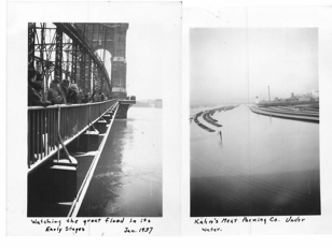
Walter took photos of the flooded area in 1937:
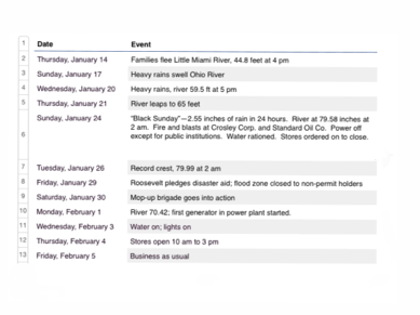
Here is a timeline of events from the Cincinnati Post, dated Saturday, February 13, 1937. It covers the flood for a two week period from January 14 when the waters began overflowing their banks to February 5, when business in Cincinnati returned to usual.
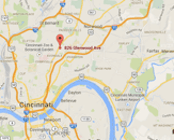
The Glenwood Avenue house was just outside the reaches of the flood. It was 3 miles from the Ohio River and 3 miles from Mill Creek. Nonetheless, the effects of the flood impacted them dramatically. Since the services of the city had virtually shut down, the family’s power, water supply and travel were severely restricted.
Bob Travis was 13 years old at the time of the flood and living in the Glenwood Avenue house with his family. He was a boy scout at the time and remembers working with his troop to take water to the people who were flooded. Roslyn and Walter were also living in the Glenwood Avenue house at the time of the flood. As luck would have it, Roslyn was writing letters to Walter just after the Black Sunday when most of the city was shut down. So we have a written record of the effects of the flood. Walter had taken a job seeing to the medical needs of a Mr. Brown who was traveling on business (he was a fashion buyer). That’s why he was away and why Ros was writing to him. Here are excerpts from her letters showing the effects of the flood on the family:
January 30, 1937: Chip has been very busy this evening with “typhoid shots”…Iwonder what you are doing now? You are probably quite comfortable and clean on the train. I certainly do hope that I’m able to bathe soon. Perhaps you could send me a teeny weeny bit of all that expanse of water at your disposal.
No date, Wednesday nite: I am going over to my mother’s with Chippie. He is going to give the entire family and a couple of kids from the store typhoid vaccine.
February 1, 1937: Still writing by candlelight dearest. The river is going down gradually, but is still bloated at 71+. A few street cars are to be in service tomorrow and they expect to have water running in the pipes by Thursday. It certainly will be a relief.
February 5, 1937: Speaking of showers, I don’t think I’ll take one, for the simple reason that our hot water heater is on the blink. The irony of fate! After waiting 2 1/2 weeks until the water flows gently through the pipes — it has to be ice cold water. So, at the present moment everyone in Cincy has hot water and has bathed, ‘cept the dirty Felsons and as for you, my dear husband, gloating over your cleanliness, you should be ‘shamed.
No date. Tuesday. Phil just returned from Louisville, where he went on business. He said conditions are deplorable, no heat, light, or water. He saw Nathan, who was not disturbed much by the flood, only a few feet of water in the store. They are all moved back again.
February 7, 1937: Conditions following the flood are practically normal now, save for boiling drinking water for 10 minutes. To date there has been no cases of typhoid and very little other diseases. I hope this continues.
February 8, 1937: To date we have given 701 typhoid inoculations at the clinic, and I’m going dizzy trying to keep my records up to date…Whoopie! we now have hot running water. Time for a good long soaking.
 The Felson Family