(1902-1989)
Born in Warsaw, Poland in 1902. Emigrated with his mother and sister to Newport, Kentucky at 1 year old. Moved frequently with family through childhood, ending up in Cincinnati where he attended a west end high school. Talented athlete—tennis and bowling. Married Rosalyn Totz in 1935. Had two children, Nancy and Alan. Owned and ran a bowling alley in Cincinnati (Felson Bowling Lanes). Supported Felson siblings financially and otherwise, especially during World War II. Died in 1989.
Biography
Itzak Mayer Felson was born in born in Warsaw. Irv’s Hebrew name was Itzak Meier. He was named after his father’s brothers. In 1904, when he was a year or so old, his mother took him and his older sister Sophie to America. Esther left her parents and family to join her husband Solomon Felson who was living in Newport, Kentucky.
Esther’s mother tried to talk Esther into leaving the infant Irv in Russia. Esther refused to leave him in her mother’s care and was was always angry with her mother for even suggesting such a thing.
Growing up in the West End in Cincinnati
Many of the people Irv grew up with in the West End of Cincinnati ended up in jail for gambling—a rough neighborhood and times were rough.
What saved the Felson brothers from being part of a gang was their dedication to athletics. The athletic team that the Felson brothers played for was sponsored by Ruble’s Bakery and Young Men’s Hebrew Association.
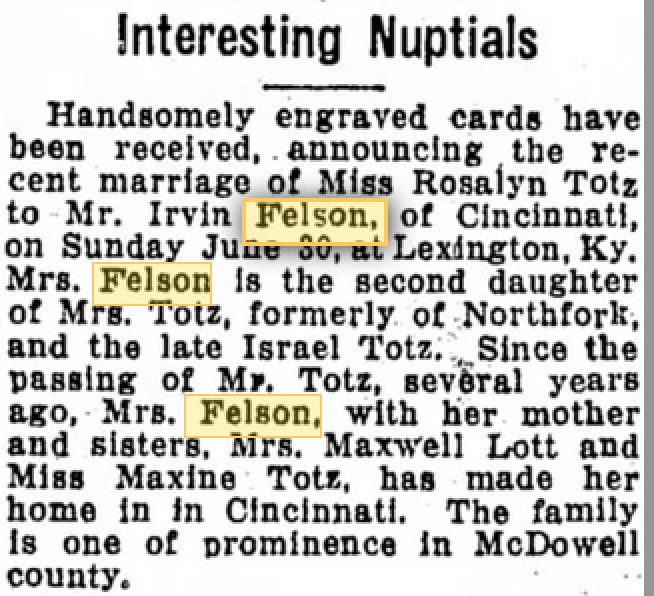
Irv married Rosalyn Totts in 1935.
Occupations
Bookie
Irv worked as a bookie until 1951, when a federal gaming stamp was required. Some of the Felson brothers worked for Irv when he was a bookie, including Alan Travis. He worked in St Bernard, a suburb of Cincinnati.
The police in St. Bernard were paid off, so Irv had no problems with arrests until much later when the Kefauver Commission got involved in Newport to break up the gambling. So that sort of ended that. Irv got out of the bookmaking business at that point. He opened a bowling alley, and I worked for him there, setting bowling pins. I had to pay careful attention at that job, to make sure I didn’t get hit by a flying pin when the ball was delivered. (Alan Travis) Owner of Felson Bowling Lanes (The spelling of Felson is incorrect in this article—not Felton. It is dated 1959)
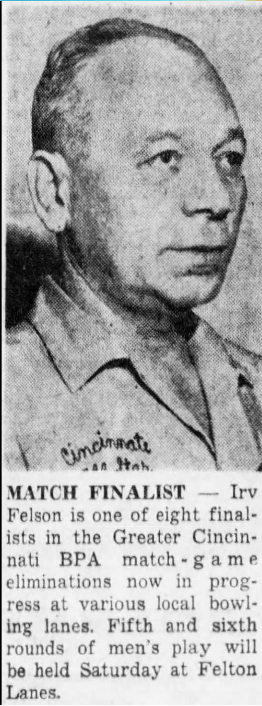
Irv bought a bowling lane business at 3118 Reading Road in 1944. Roslyn Felson wrote to her husband Walter about Irv’s purchase: Irv says his business is wonderful and they have purchased the restaurant too. I’m glad he finally is in a legal business. I know it makes Rosalyn much happier — it always did worry her. (Roslyn Felson, February 10, 1944.)
A number of family members worked at Felson Bowling Lanes over the years, including Alan and Bob Travis, Ira Tott (Irv’s nephew) and Nancy (Irv’s daughter).
Here is Alan Travis’s recollection of his job: I worked at Felson’s Bowling Lanes for several years, primarily setting pins. I started working there before he had automatic pin setters. When you set pins, you stood in the pit between two alleys and set the pins while the other lane was bowling and then stood in the middle after the pins were set in the first lane so you could set the pins after they finished bowling in the second lane. I received quite a few bruises on my legs while setting pins because of the pins went flying around after being struck by the bowling ball. I sometimes got struck by the bowling ball plus the pins when people would bowl while I was still in the pit. It was not an easy job, but the pay was reasonable at that time. Irv occasionally had me working in the kitchen. (Alan Travis December 20, 2014)
Other Cincinnati children of Irv’s siblings, have fond memories of Irv’s bowling lanes. Here are the recollections of Jane Felson Brown:
I loved going to the bowling alley. It was a great weekend treat, and uncle Irv always made Lois and me feel like such special, personal guests. He’d introduce us to his “regulars”, make sure we had plenty to eat and drink. Then e’d take us down to a lane and give us a bowling lesson, and leave us to bowl by ourselves. Unfortunately, I was an inept pupil, and with each gutter ball I threw, I could see Uncle Irv moving closer and closer, watching me until finally he could not resist coming back down to us, taking me aside, and repeating the basic lesson I clearly had failed to learn. He was always very patient with me, but he was also obviously disheartened that my game never improved no matter how much time he spent working with me. My memories of Saturdays spent at Felson’s Bowling Alley are very happy ones. I suspect Uncle Irv’s memories of my visits were not the same.
Many years later, I met some children of his “regulars” when I became involved with The Arts Consortium. I discovered that the name Felson was magical within the black community: Uncle Irv was the famous Felson there. He owned the only bowling alley that accepted black customers, but more importantly, I was told, he was beloved for his color blindness in the relationships he had within the black community. He was the one who made a difference, without carrying signs of marching, or making lots of noise. (Jane Felson Brown, August 2003)
Irv was audited by the IRS in 1953-1954. He had a heart attack as a result of the tension from the two years of auditing. He had another heart attack in 1963, 10 years later.
The business continued in to the 1960s. A blogger has describes its demise thusly:
Felson Bowling Lanes were a short bike ride from Paddock and Reading. And they had human pin-setters for as long as I can remember. Then in the early 1960s an ex-teacher from North Avondale opened a bowling alley in St. Bernard called “Spring Bowl.” Also a bike ride away (when it was warm) and everyone stopped going to Felson’s because Spring Bowl was really modern. (from allmybengals).
Irv as a supporter of his siblings and children throughout their lives
His siblings in high school:
Irv went to Salmon Chase after high school, but he did not go to college. The family needed him to work. However, he was the one who educated all the kids in math (Alan Travis).
Uncle Irv was a bookmaker in St Bernard. Bob and Leo worked for him there, answering the phone and taking bets (Alan Travis).
During WW II:
Irv supported the families of his brothers when they were off to war. Four of his brothers enlisted. Below are some examples of how he was there when needed.

Irv came to Trenton to drive with Ros and the kids back home once they had seen Walter off to the war. (Roslyn Felson)
I called Irv tonight to tell him I had 6 v mail letters from you and also to find out how Steve was. He was operated on Saturday and Irv says he’s fine. It’s a good thing Ginny is no worry wart like me. Irv was at the hospital with Ginny and Steve all day. Good old Irv – always around when needed most. He did remark that he feels it is his duty since everyone else is in the army and he isn’t – but you know he would do the same under normal circumstances. Remember how he and Rosalyn stayed with me before Judy’s arrival? (Ros to Walter, January 24, 1944).
Have Irv check your hospital bill if you have any doubts about it. After all, he is an accountant. You might have Sel or Irv find out about income tax. I’m almost positive we are exempt and may even have some money coming back. Why doesn’t Irv do some taxwork this year. It’s so complicated that it will take men like him to do it. (Ben Felson to Ginny, February 23, 1944).
His support of his own children
Irv spent considerable time with Alan and Nancy (his children) when they were young. He took them to tennis courts, Jewish Center, swimming. He did lots of physical stuff with them. (Nancy Brant, October 28, 2002).
 The Felson Family