By Kenneth Clifford
| The following essay about Walter Felson is by a Greenfield, Ohio resident, Kenneth Clifford. Ken who wrote about Walter Felson for a blog called “Greenfield folks for Greenfield folks”. It appeared on Facebook on January 16, 2026. A few corrections and updates to Kenneth’s original post have been made by Walter’s children, Judy Felson Duchan and Elaine Felson Vanzant (in red). Kenneth loved the changes. Here is a link Kenneth’s original posting on January 16, 2026: https://www.facebook.com/groups/2974719029500150/posts/3851525158486195 |
Before dawn broke over Greenfield, a single light often glowed in the front room of the house at South and Fourth Streets. It was always the same light — steady, warm, and unmistakable. People passing on their way to early shifts at the factory or the bakery knew what it meant. Dr. Walter Felson was already awake.
Inside, the house was quiet except for the soft clink of a coffee cup and the rustle of a medical journal folded beside the exam table. The office door — just steps from the family’s living room — was unlocked before most of the town had stirred. Sometimes a farmer would knock, hat in hand, apologizing for the hour. Sometimes a mother would arrive with a feverish child wrapped in a blanket. Sometimes Walter would already be shrugging into his coat, heading out for a house call before the sun touched the rooftops.
He never hurried them. He never turned anyone away.
This was the rhythm of his life — the life he chose — long before the town fully understood how much that choice meant.
Walter came from a remarkable medical family. His brothers, Ben and Henry, became well known specialists in the medical field, Ben internationally, Henry (Chippy was his nickname) in Cincinnati. Walter had the same training, the same credentials, and the same opportunities as his brothers, but he chose something different. He chose Greenfield — a small town, a connected community, a place where a doctor wasn’t just a specialist but a neighbor.
He married Roslyn Marcus in 1930, and together they built their life on South Street. By 1940, they were raising their infant daughter, Judith, when their lives were suddenly interrupted by an accident that became part of the family’s story.
On November 21, 1940, before America entered World War II, the Felsons were driving along Route 28 between East Monroe and Leesburg on their way to Thanksgiving dinner with relatives in Cincinnati. As a stock truck driven by Clifton McKinney turned into his farm lane, the vehicles sideswiped. The right rear door of the Plymouth sedan tore open, and Rosalyn and baby Judith, seated in the back, were thrown from the car onto the roadway. Rosalyn suffered a fractured pelvis; Judith was bruised and cut on the forehead. Neither Walter nor McKinney was injured.
This was 1940 — before seatbelts, before child restraints, before life squads, before trauma protocols. Walter acted immediately, arranging transport via an R. B. Walker invalid coach to Jewish Hospital in Cincinnati, where X‑rays confirmed Rosalyn’s injury. Judith was treated for her cuts and bruises. Rosalyn resumed her life, shortly afterward.
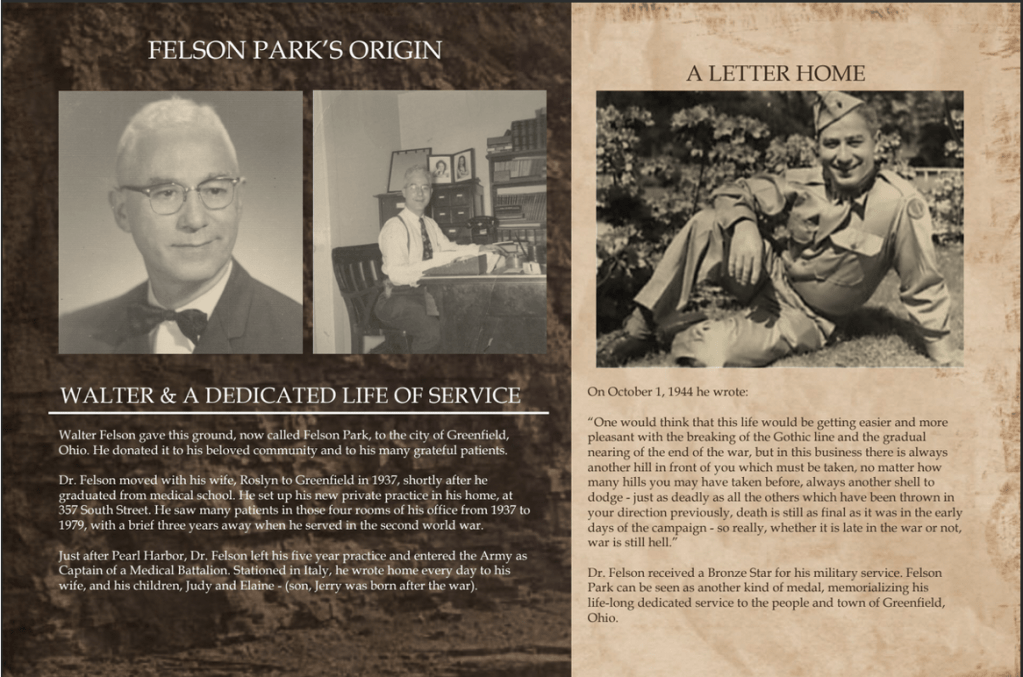
Not long after the accident, the world changed. When the United States entered World War II, Walter temporarily closed his Greenfield practice and entered the Army as a medical officer. He served as a captain and earned the Bronze Star for meritorious service. When the war ended, he didn’t move to Cincinnati where his brothers practiced. He didn’t pursue a hospital appointment or an academic post. He came home — back to South Street, back to his patients, back to the community that had waited for him. Here are his sentiments about that return that he wrote when he returned to Greenfield after his training program in the army: “My patients have not yet forgotten me and kept me busy dropping in on me and telephoning. It made me feel good and I’m more sure than ever that I’ll return to that town to practice despite having seen most of the country” (October 25, 1943).
By the 1950s, Greenfield’s hospital — built in 1915 — was aging and too small for the town’s needs. Walter wasn’t trying to create a hospital; he was trying to save it, modernize it, and attract enough doctors so Greenfield wouldn’t lose medical care altogether. During Community Action Weekend, he went on local radio urging support: “We must raise at least $50,000 to show the government we are serious.” The goal was simple: upgrade the hospital so new doctors would come — and stay.
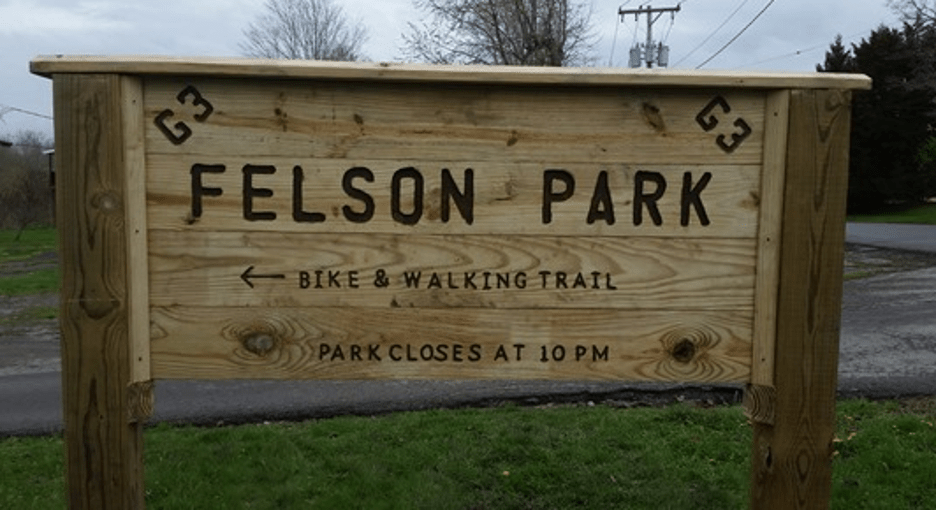
Walter’s civic commitment extended beyond medicine. In 1957, he donated 125 acres along South Front Street to the Village of Greenfield for a recreation center, a gift that reshaped the community’s landscape and future. Called Felson Park, recent 2025 plans are to develop the acreage to include a regional bikeway and house a venue for Greenfield’s cultural events. The park will also serve as a trailhead for bikeway activity and a canoe and kayak blue-way trail extending to Paint Creek Lake, where camping and outdoor recreation sites are available.
A historical marker, a memorial to Walter Felson, will be prominently displayed in the newly designed Felson Park. Here it is:
As the years passed, the Felson children grew, and the family’s story continued to unfold. In the early 1960s, Judith — the same baby who had survived the 1940 accident — married Alan Duchan in a beautiful ceremony at the Netherland Hilton in Cincinnati. The event brought together the extended Felson and Marcus families, a reminder of how far the family had come since those early years on South Street. For Walter and Rosalyn, it was a moment of pride, joy, and continuity — a milestone that marked the next chapter of the family’s life.
But Walter’s legacy wasn’t built on ceremonies or public honors. It was built on presence. People in Greenfield didn’t talk about him because of his degrees or his brother fame. They talked about him because he showed up. He showed up when babies were born. He showed up when fevers spiked. He showed up when someone’s father collapsed in the yard. He showed up when a family couldn’t pay. He showed up when the roads were bad, when the nights were long, when the town needed him. He wasn’t just a doctor. He was their doctor.
Walter practiced medicine in Greenfield for more than four decades, always from the same South Street home and office. He died unexpectedly in 1980 at age 71, in that same home.
He was laid to rest in Cincinnati, among the Felson family he came from — the brothers and sisters whose medical careers reached national prominence. But the people who filled the funeral home, the ones who spoke his name with warmth, were from Greenfield. They remembered the doctor who delivered their children, who sat at their bedsides, who made house calls in the snow, who never rushed, who never turned anyone away.
His grave is in Cincinnati.
His legacy is in Greenfield.
Walter Felson’s story is not one of headlines. It is the story of a man who chose people over prestige, service over status, and community over recognition. His life remains woven into the history of Greenfield — not because he was the most famous Felson, but because he was the one who stayed.
 The Felson Family