February 10, 1898—January 7, 1979
Phil Travis was born in Lithuania, the first child of Louis and Bessie Travis. Louis emigrated to the United States in 1903. Once here, he sent for his wife and their four children, Phil, (b. 1897), Morris (b. 1899) Rose (b. 1901) and Charles (b. 1903). They joined Louis in 1905 in Cincinnati, Ohio. Phil was 8 at the time. Amy Travis recalls that Phil remembers coming to the United States, whereas his 6 year old brother Morris did not.
Morris offered a recollections of the time when he and brother Phil were young boys in Cincinnati:
I remember how my father, of blessed memory, used the rolling pin on Phil and myself. It was an a Sunday afternoon. We got spanked for doing “nothing”? We were chased out of the house and we sat down on a street curb till it got dark. We planned to run away, but when it got good and dark, we got scared and returned home.
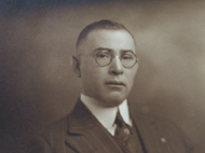
Here is Phil (we think) at a very young age:
Phil’s work
Alan, Phil’s son says: My father probably started school in the second or third grade continued his schooling through sixth grade. He then began working, delivering telegrams for Western Union.
From there, Phil got a job in the wholesale dry goods business. Alan remembers:
My dad always worked for someone else. He had worked for someone who died, and he told the widow he would stay on until he sold all the stock and liquidated the business. All the others left right away to look for other jobs. Phil felt that if someone employed you and paid you wages, you owed them loyalty.
After that was finished he went to work for another wholesale dry goods house. He was a buyer and salesman for men’s furnishings. Clothing was considered suits and furnishings were underwear, shirts, and shoes. He would never let me wear blue jeans or overalls, because he considered them to be poor peoples’ clothing. To this day I can’t comfortably wear blue jeans.
That dry goods business was Zussman and Sons. Several of Phil’s fellow workers at Zussman’s helped him celebrate his 50th wedding anniversary by recollecting events at Zussmans. Horace Weissfeld:
A few years ago, around eight o”clock in the morning on a Sunday, a customer of mine entered the Sample Room to buy ties from us. Mr. Zussman came in and exchanged greetings with the customer and during this time the customer mentioned that Phil was betting at the time on a certain political party whose candidate was running for President of the United States. Upon hearing this announcement, Mr. Zussman immediately said “Knowing Phil’s luck, I will bet on the other party to win.”
Phil’s Religious Practices
Phil was an observant Orthodox jew all of his life. His son Alan comments on Phil’s Jewish orthodoxy:
My father would walk from Bond Hill to Avondale to go to schul, on the High Holidays, and usually he would stay over at a friend’s house in Avondale. My mother would come in the next evening. She’d take the bus, and they’d walk, or take the bus back if it was after sundown. He would think nothing of it.
I used to take the bus into Avondale. I’d go to see him at shul. I’d sit next to him for maybe a half hour. It was on Forest Ave. I spent a lot of time at Seasongood Park across the street. That was Forest Park Synagogue at that time. It later became Golf Manor Synagogue. Agudeth Israel was its Jewish name. It was Orthodox.
My father said: “I have to keep going because they would expect it of me because of my father.” Phil had a very strong sense of what’s right, what’s proper.
Occasionally he would go to a Conservative Synagogue which was probably much more comfortable for him. He had two memberships, but he’d go to the Orthodox one on the High Holidays because the people who knew his father would expect him to be there. I think he had two memberships.
He would always insist that I go see his sister Aunt Rose who went to Washington Avenue Synagogue. So I would go over there and sit with her in the balcony for a little bit, and then I’d come home. I didn’t fast on Yom Kippur. It wasn’t for me. My mother didn’t fast, and she stopped keeping a Kosher house after my father’s parents died.
Phil was active in the Golf Manor synagogue as depicted by several who attended Phil and Sophie 50th wedding anniversary.
Samuel Schwartz wrote Phil’s children:
His whole heart and soul was Rabbi Indich and its Board of Directors and members. [Your] dad had the extreme pleasure of giving out the “Alias” on Honour Cards to the members on all holidays. When it came from picnics he was always ready and willing to do more than his share in contacting people to donate or buy raffle tickets, etc.
Phil was a strict disciplinarian at the the Golf Manor Synagogue. Here he is compared to various demagogues: USA: Nixon has Kissinger; China: Cho En Lai has Mao Tse Tung; Golf Manor Synagogue, Harry B Solomon and Monroe E. Berkowitz have Phil Travis.
Rabbi Indich wrote to Phil’s children 1972:
I am sure that you realize Phil’s dedication to our synagogue. He is most concerned that we have a daily minyan and that our finances are in good order. five years ago he said to me, “Rabbi, if I live another five years, the Synagogue will have no financial problems you can be sure of that”. To keep faith with the pledge he has instituted a “Burn the Mortgage” drive, of which he is Honorary Chairman. When I visited him in the Intensive Care unit of the Jewish Hospital approximately three years ago, he opened his eyes, saw me and said, “Don’t worry Rabbi; I’ll be out soon and start coming daily and keep the promise I made you”.
Phil’s Character
Phil was seen as a quiet person, unassuming, kind, generous. His reticence to hold forth in a group may have had to do with his stuttering. Judy became a speech pathologist well before Phil died, but never talked to him about his stuttering. Somehow it didn’t feel right to ask him about whether he ever had had therapy, whether he stuttered as a child, and what he thought about it—though I wanted to. I also felt that he might be interesting to clinicians or researchers whose specialty was stuttering because he had myasthenia gravis that resulted in the relaxation of muscles involved in stuttering. The effect of the disease on his speech, or so I reasoned, could shed light on what is going on when someone stutters. But, all these questions and issues felt academic, intrusive and not appropriate. It didn’t feel right to objectify Phil and treat him as a case rather than a beloved uncle.
Phil’s generosity was legion. Here’s Amy’s, his granddaughter’s recollection:
My dad (Alan) told me that Sophie put Phil on a strict allowance, because he would give money to anyone who asked him for it. I remember that even just before he died, he wanted to give me money, and had his nurse write out a check, which my dad said I couldn’t cash because he didn’t actually have the money to give.
Phil’s had a loving nature, that showed up in many ways. He was always affectionate toward Sophie, as observed by Ros in her war letter to Walter:
I really marvel at the strong affection between those two. He simply adores her — they still hold hands after all these years and Soph threw her arms around Phil when he came in from NY — she was so happy to see him. I know there is a strong physical attraction and they must be very well mated sexually. Then Phil is so easy going and gives in to Soph’s every whim — altho he realizes and teases her about her faults.
Another example of Phil’s ardor (or avarice) comes from Amy’s memory: “he used to follow flower trucks at the end of the day and take what they threw away—maybe to give to a girl? or maybe to resell.”
Phil played gin rummy regularly on Monday nights. For some reason, was called “The Tiger” by his gin club buddies.
And there was the dancing!
Morris, Phil’s brother: I remember when Phil was the “dandy” of the West End, because he was the best dancing partner. He was called the Jewish Vernon Castle. And friends Earl and Mollie rhymed: Phil was the top dancer in Cincy, who could ask for more. In every contest, his beat “Toots Marshall” to even that score.
Myasthenia Gravis
In his last years Phil suffered from a nervous disease that affected his ability to move his muscles. Sophie comments to her relatives about Phil’s myasthenia gravis on April 7, 1964 around the time it was diagnosed:
Phil is feeling about the same. He has his good days and bad ones, and tires very easily. He leaves work a little early, but not too much, and lies around most of the evening. He still plays gin rummy on Monday night, though, and seems to last through the evening alright. Dr. Trufant, his neurologist, told me that Phil is doing alright, and that he’s probably depressed by this whole thing, which happens frequently with people who have myasthenia gravis. I’m just thankful that he’s no worse than he is. When I look around me and see what is happening to many of our friends, I guess our troubles aren’t so much.
Sophie’s Death
Alan’s comment on Phil after Sophie died: My father knew that he could not live alone, and went to the Orthodox Jewish Home after she died. He had been on the Board there and he just went there. It was like a hotel for him. Someone would pick him up and go to shul together; then someone would pick him up and have breakfast, and he’d go downtown to go to work.
 The Felson Family